Editor’s Disclosure
HEREClemson.com is published by HERECity Network, an independent local news organization. Your Indoor Golf Solutions, the subject of this article, has a business relationship with HERECity Network as a technology and services partner. This article was reported, written, and edited by a HERE editor to HERECity Network’s editorial standards. Your Indoor Golf Solutions reviewed the article for factual accuracy regarding its own business operations only; editorial judgment and final publication decisions rest with HERECity Network. See our Editorial Standards.
Ask ten golfers in Clemson what “simulator technology” means and you’ll likely get ten different answers — some picture a projector and a screen, others picture the radar-and-camera systems tour pros use to fine-tune a swing. Both are technically correct, and the gap between them is exactly why shopping for a simulator, whether for a home rig or a commercial bay, can get confusing fast.
The category has grown fast enough that the terminology hasn’t fully caught up with consumer understanding. The global golf simulator market is projected to grow from $1.97 billion in 2025 to $3.35 billion by 2031, a 9.37% compound annual growth rate (Mordor Intelligence) — and a broader indoor golf simulator market forecast from Business Research Insights puts the number at $1.86 billion in 2026, climbing to $6.95 billion by 2035. That kind of growth has brought a flood of new brands and technology tiers into a market that used to have just a handful of serious players.
For a Clemson buyer — whether that’s a homeowner, a bar owner near campus catering to a college crowd looking for something to do on a weeknight, or a coach setting up a practice facility — understanding what’s actually different between systems matters more than picking a familiar brand name.
Camera systems vs. radar-based tracking
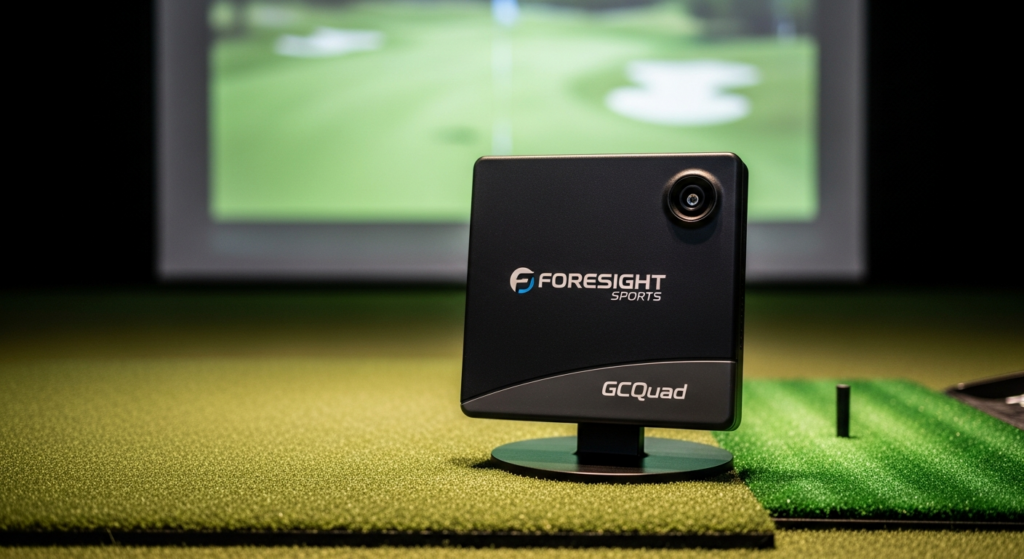
Most simulator technology falls into two broad camera-and-radar categories, and each has real tradeoffs. Camera-based systems capture extremely detailed data at the moment of impact, which tends to produce very accurate short-game and putting data. Radar-based systems track the ball’s full flight path, which can be more forgiving of setup variance and works well in tighter spaces. Foresight Sports’ GCQuad and GC3 units, among the most widely used in both commercial venues and serious home builds, use a hybrid camera approach specifically to capture both impact and flight data with high precision.
The practical difference shows up most when a player is trying to actually improve, not just play a round indoors. Entertainment-oriented setups can get away with looser tracking tolerances; a setup meant for real coaching or handicap improvement generally can’t.
What actually separates the tiers
Price differences between simulator setups usually trace back to three things: launch monitor accuracy, projector resolution and throw distance, and software course libraries. A budget setup might use a lower-cost radar unit and a standard projector; a premium build pairs a high-end monitor with short-throw 4K projection and a full slate of licensed courses.
None of those upgrades matter equally to every buyer. A bar near campus running casual walk-in traffic for a college crowd has very different priorities than a home user trying to shave strokes off a single-digit handicap — which is exactly why a one-size-fits-all recommendation from a retail salesperson often misses the mark.
Buying for the use case, not the spec sheet
The instinct to buy the most advanced launch monitor available is understandable but often wasteful. A system built for tour-level data capture is overkill for a casual bar crowd, just as an entry-level unit will frustrate a serious player chasing real improvement.
Matching technology tier to actual use case is where an experienced, brand-agnostic consultant adds the most value — someone who has installed enough systems across enough contexts to know which spec sheet claims actually matter for a given buyer.
Projectors and screens matter more than buyers think
Launch monitors get most of the attention in simulator conversations, but projector choice and screen setup shape the actual experience just as much. Short-throw projectors capable of true 4K resolution reduce shadow interference from a player’s own swing, a detail that matters more in a tighter Clemson garage or bar corner than in a wide-open commercial bay. Panasonic, BenQ, and EIKI units are among the more common commercial-grade choices for this reason.
Buyers often underweight this part of the build because it’s less flashy than launch-monitor specs, but a mismatched projector and enclosure size can undercut even the best tracking technology by making the visual experience feel cramped or washed out.
Local Sports Lens
Your Indoor Golf Solutions, PGA Pro-owned by Greg Sheffield, has spent 25 years installing indoor golf simulators for homes, businesses, restaurants, and bars. The company works with clients nationwide — including South Carolina — and provides consulting on which technology tier, space configuration, and F&B integration makes sense for a given venue. Businesses considering a simulator install can request a consultation at (309) 826-0439 or via the HERE partner page.
The technology behind indoor golf keeps getting more capable every year. Knowing which capability is worth paying for is still, mostly, a matter of experience.