As summer progresses in Clemson, many local outdoor enthusiasts are already turning their attention to the meticulous preparations required for the upcoming spring turkey hunting season. The pursuit of wild turkeys demands not only skill and patience but also a comprehensive array of specialized gear, carefully selected and tested long before the season’s opening day. This preseason readiness is crucial for success and safety in the diverse landscapes surrounding Clemson.
A fundamental aspect of legal and ethical hunting, especially in South Carolina, involves proper tagging. Hunters are consistently reminded to keep their turkey tags readily accessible, along with a pen, to ensure immediate compliance should they successfully harvest a bird. This simple practice prevents potential legal complications and underscores responsible hunting practices.
Wild turkeys possess exceptionally keen eyesight, making concealment paramount for hunters. In the hardwood ridges and pine flats characteristic of the Upstate region surrounding Clemson, camouflage patterns designed to break up a hunter’s outline are essential. Beyond clothing, gloves and face masks are critical for covering exposed skin, minimizing movement detection by wary birds. The varied terrain near Lake Hartwell and the Seneca River, for instance, often dictates specific camouflage needs.
Most states, including South Carolina, permit the use of shotguns, muzzleloaders, or archery equipment for turkey hunting. For those opting for a shotgun, ensuring the firearm is clean and functional is a baseline. Bowhunters face additional considerations, needing to verify their setup is not only tuned for accuracy but also compliant with state-specific regulations. Practice from realistic seated positions, mimicking actual hunting scenarios, is vital for both shotgun and archery users.
Preseason is the time for rigorous testing. Shotgun hunters should carry sufficient ammunition to pattern their chosen firearm, ensuring optimal pellet distribution at various ranges. This involves testing a properly installed turkey choke, matched precisely to the ammunition type, to achieve a dense and consistent pattern. For bowhunters, researching and testing broadheads for accuracy, penetration, and reliability is non-negotiable. This preparation minimizes ethical concerns and maximizes effectiveness in the field.
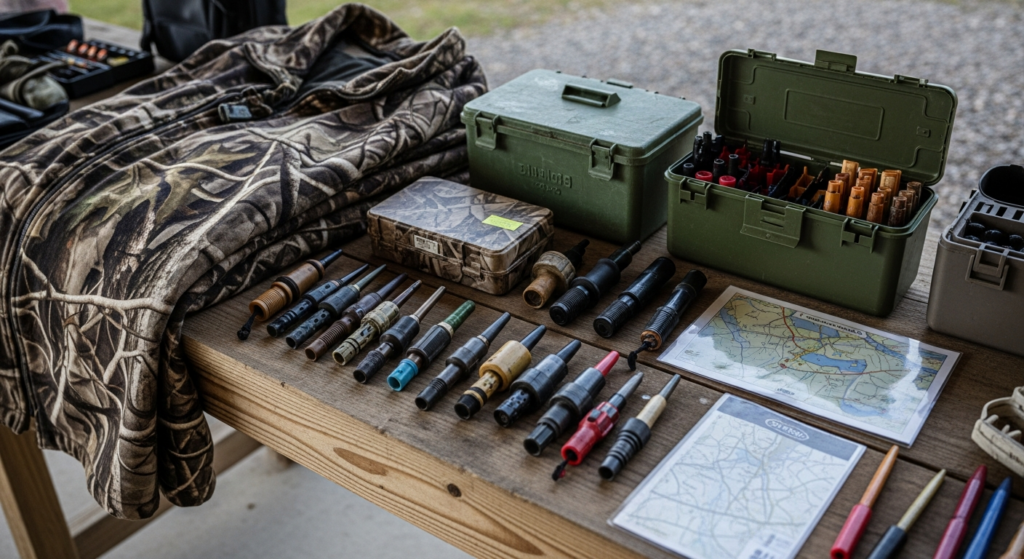
Effective communication with turkeys relies on a diverse repertoire of calls. Hunters often carry multiple types, including diaphragm calls, slate or glass pot-and-striker calls, box calls, and even traditional wing bone calls, each offering distinct sounds to mimic different turkey vocalizations. Beyond calls, modern mapping applications such as HuntStand and onX Hunt have become indispensable tools. These platforms allow hunters to identify property boundaries, pinpoint access points, locate potential roosting habitat, map travel corridors, and confirm legal hunting areas, a critical advantage when navigating public lands or private leases in the Clemson area and Pickens County.
Beyond the primary hunting tools, a range of essential field gear supports a successful and safe outing. Adequate water and food are crucial for sustained effort, particularly during long waits. A sharp, reliable knife is indispensable for field dressing and processing. Optics, such as binoculars, aid in scouting and identifying distant birds. A compact first aid kit addresses minor injuries that can occur in rugged terrain. Finally, a well-organized turkey vest or lightweight backpack helps consolidate calls, ammunition, water, and other equipment, keeping necessities within easy reach.
Given the conditions often encountered during spring hunts, comfort and protection are key. Clothing treated with permethrin offers a strong defense against ticks, which are prevalent in the region. During peak mosquito season, a portable Thermacell unit can provide a welcome reprieve from biting insects, allowing hunters to remain focused and still. While these are often considered optional, they significantly enhance the hunting experience.
Ultimately, adherence to South Carolina’s specific turkey-hunting rules is paramount. Hunters must familiarize themselves with bag limits, season dates, and any special regulations for the areas they intend to hunt. Optional gear, such as rangefinders for precise distance measurement or shooting sticks for added stability, can be tailored to individual hunting styles and the anticipated conditions of the hunt, whether in the dense woods near the Twelve Mile River or more open areas.
Why it matters in Clemson
The robust interest in outdoor recreation, including hunting, holds significant implications for Clemson and the surrounding Upstate region. For residents who work at institutions like Clemson University or Prisma Health Oconee Memorial Hospital, or who live in neighborhoods such as Patrick Square, engaging in activities like turkey hunting offers a direct connection to the natural environment and a traditional pastime. The preparation for these seasons supports local retailers that supply outdoor gear and contributes to the broader economic activity tied to recreation in Pickens County. Furthermore, responsible hunting practices, emphasized by the need for proper licensing and gear, play a role in wildlife management and conservation efforts across the state, ensuring the health of local ecosystems and the continuation of these traditions for future generations in Clemson.